The country’s trade deficit has widened by 54 percent in the 12 months ending November this year largely due to the decline in sales of key commodities such as tobacco, pulses, tea and natural rubber, data shows.
Economists say the development will continue to heighten inflationary pressures and foreign exchange scarcity.
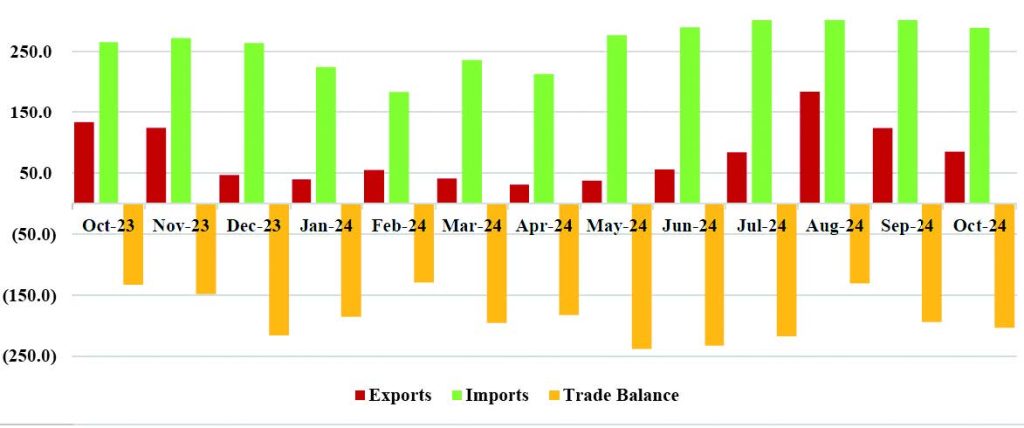
Reserve Bank of Malawi (RBM) data shows that trade deficit widened to $203.8 million (about K356.8 billion) in November this year, a rise from the $131.9 million recorded during the same period last year, representing a 54 percent negative trade balance.
The data further shows that between October and November this year, the trade deficit marginally widened by 7.3 percent.
The RBM Monthly Economic Review Report shows that tobacco exports, which are a major source of the country’s foreign exchange, fell sharply from $93.9 million (about K164 billion) in October to $58.9 million in November. Similarly, tea exports declined from $4.3 million (about K8 billin) to $3.8 million (about K7 billion) while natural rubber exports dropped from $400 000 (about K700 million) to a paltry $ 100 000 (about K175 million).
While there were some positive developments such as an increase in groundnut and sugar exports, the increase was not enough to offset the significant decline in other key commodities.
On the import side, there was a slight increase in imports from $316.4 million (about K553 billion) to $288.5 million (about K502 billion). This was mainly due to reductions in purchases of fuel, fertiliser, pharmaceuticals and other essential goods.
However, imports of certain items such as vehicles, printed books and electrical machinery, increased during the month.
The perpetual trade deficit has seen the country’s total foreign exchange reserves dropping to $519 million (about K909 billion), an equivalent of 2.1 months of import cover from $560.3 million (about K981 billion), representing 2.2 months of imports recorded in September 2024 and $566.2 million (about K991 billion) or 2.3 months of imports during the same period in 2023.
Reads the report in part: “The outturn followed a decrease in private sector reserves to $386.5 million [about K676 billion], an equivalent of 1.5 months of imports from $433.1 million [K758 billion] or 1.7 months of imports in September 2024.”
Scotland-based Malawian economist Velli Nyirongo, in an interview on Monday, cautioned that the trade deficits and the declining forex reserves that follow will likely limit the country’s capacity to import essential commodities such as fertiliser and fuel.
He said: “Without sufficient foreign reserves to purchase these goods, there could be severe disruptions to economic activities, food security, and overall stability.
“Shortages could also lead to higher prices domestically as businesses pass on the costs of acquiring scarce goods to consumers, further exacerbating inflation.”
At a budget report dissemination meeting co-facilitated by Oxfam in Malawi and the Economics Association of Malawi, economist Wytone Jombo cautioned that persistent forex problems could undermine the country’s growth prospects.
He said: “Persistent foreign exchange shortages threaten to impede growth across multiple sectors.
“These shortages significantly affect businesses reliant on imported goods and services, particularly in the manufacturing and retail industries.”
The RBM projected that the economy will rebound from 1.8 percent this year to four percent in 2025 on account of favourable weather conditions and a subsequent rebound in agricultural production.